

Paddle Boarding Essentials for Beginners
Your first paddleboard setup is simpler than most gear lists make it sound. Start with a stable board that fits you, a correctly sized paddle, a life jacket, the right leash for the water, a sound signal where required, and protected storage for the small things you cannot afford to lose.
For a first flatwater session, bring a stable all-around board sized for your body weight, an adjustable paddle, a properly fitted U.S. Coast Guard-approved life jacket, an appropriate leash, a whistle or other efficient sound signal when federal vessel rules apply, and sealed storage for your phone, keys and car fob. Choose calm water with little to no wind and learn the remount before paddling far from shore.
Do not buy a board from one magic width number.
The old version of this guide treated 32 to 34 inches as the beginner answer. That range can be a useful starting point, but it is not a rule. A board has to support your weight and match your height, balance, intended water and the kind of paddling you want to do.
REI's current SUP buying guide makes the tradeoff clearer: wider boards generally add stability, while narrower boards can feel faster and easier to paddle for smaller or more experienced users. Volume and published rider capacity matter too. A board that is too small for the paddler can feel unstable even if its width sounds “beginner friendly.”
The right first-session question is therefore not “Is it 33 inches wide?” It is: Will this board support me comfortably, feel stable enough to learn on, and suit the water I am actually paddling?
Everything else is an add-on to these.
A stable board that fits your load
Match rider weight to the published capacity and favor stability over race speed while you are learning.
An adjustable paddle
An adjustable shaft makes it easier to find a comfortable length while you learn proper posture and stroke technique.
A properly fitted life jacket
Federal carriage rules apply when a SUP is used outside the narrow limits of swimming, surfing or bathing areas. Wearing it is the safer choice.
The right leash for the water
Flatwater, surf and moving rivers create different entanglement risks. One leash type is not correct everywhere.
A whistle or other sound signal
Vessels under 39.4 feet need a means of making an efficient sound signal under federal navigation rules.
Waterproof storage
Phone, keys and electronic car fob should have a sealed home that remains attached to you or securely attached to the board.
Width helps, but the whole board determines how stable it feels.
REI currently notes that SUP widths span roughly 25 to 36 inches. Newer paddlers often prefer the more secure feel of a wider board, but rider size, volume and weight capacity matter just as much.
If you are at or near the board's weight limit, it can ride lower and feel less stable.
REI describes planing hulls as stable and easy to maneuver, while hybrid designs can balance tracking and stability.
A very wide board can feel slow or awkward for a smaller paddler. A larger paddler may appreciate the added volume and width.
Inflatables pack smaller and travel easily. Hard boards avoid setup time and can offer a more direct, rigid feel. Neither format is automatically “best for almost every beginner.” If you are still choosing a craft, compare kayaks and paddleboards for beginners before buying.
The federal minimum is not always the safest choice.
Once a stand-up paddleboard is used beyond the narrow limits of a swimming, surfing or bathing area, the U.S. Coast Guard treats it as a vessel for federal carriage requirements. State and local rules can be stricter, so check the water you are actually using.
The Coast Guard says a SUP is considered a vessel once it is used beyond those narrow areas.
A properly sized Coast Guard-approved wearable PFD must be aboard. The Coast Guard recommends wearing it rather than simply stowing it.
Under federal law, children under 13 on an underway vessel must wear an approved life jacket unless an exception applies. State laws can differ.
For vessels under 39.4 feet, the Coast Guard requires some means of making an efficient sound signal. A whistle is the easiest SUP solution.
The same leash that helps on a lake can become an entanglement hazard in moving water.
The American Canoe Association describes a leash as a key safety tool in many, but not all, environments. Its guidance separates surf, flatwater and whitewater rather than applying one ankle-leash rule everywhere.
Calm water and little wind are features, not a lack of adventure.
REI recommends a lake or pond with few obstacles and an easy wade-in launch for a first outing.
There is no universal “10 mph beginner cutoff.” Wind effect depends on direction, distance, body size, board shape and local water conditions.
REI recommends paddling into the wind on the outbound leg so the return does not become the hardest part when you are tired.
A partner gives you another set of eyes and immediate help if you lose gear, tire out or struggle to remount.
Go
- Calm lake or pond
- Little wind
- Easy launch and exit
- Daylight
- Water temperature matched by clothing
- Another paddler nearby
Change the plan
- Strong or increasing wind
- Fast current
- Thunderstorms
- Heavy boat traffic
- Cold water with no thermal protection
- No safe launch or recovery area
Use body position instead of memorizing “6 to 10 inches taller.”
REI's simple sizing check
Stand the paddle vertically with the blade on the ground. Reach one arm overhead. On a properly sized paddle, the T-grip should land around the bend of your wrist.
An adjustable paddle is especially useful when you are learning because you can change the length as your stance and technique improve.
One beginner mistake to avoid
The blade is designed to angle forward from the shaft, toward the nose of the board. New paddlers often hold it backward because the correct orientation looks counterintuitive at first.
Keep a light grip. Over-gripping the handle and shaft burns energy without making the board track better.
Learn recovery before distance.
Carry the board far enough that the fin will not hit bottom, then get on from a stable position.
Center yourself near the carry handle and paddle away from the dock, rocks and shallow obstacles before standing.
Move your feet where your knees were, keep the knees soft and look toward the horizon instead of staring at your feet.
Everyone falls eventually. Practice getting back on in controlled water before a real fall happens farther from shore.
REI suggests about an hour for the first outing. The goal is comfort and control, not mileage.
A dry phone is still a problem if the bag is floating away.
SUP storage has two different jobs. Larger gear can be secured to the deck. The small valuables you need after the paddle are usually better kept in a compact waterproof zone that remains on your body or is positively secured.
Keep close
- Phone
- Car key / electronic fob
- Wallet / ID
- Small emergency item
- Compact sunscreen or lip protection if needed
Secure to the board
- Water bottle
- Spare layer
- Larger dry bag
- Towel for short recreational sessions
- Other low-consequence gear under deck bungees
Buy the extras only when your water or routine creates the need.
Wetsuit or drysuit
Dress for the water temperature and the possibility of immersion, not just the warm air on shore.
Electric pump
A convenience upgrade, not a safety essential. Inflate to the board maker's stated pressure.
Roof-rack system
Needed when the board will not fit safely inside the vehicle. Follow the board and rack manufacturer's transport guidance.
Larger dry bag
Add one when you start carrying clothing, food, camera gear or enough equipment that the small valuables bag is no longer the right size.
The 60-second first-launch check.
Beginner SUP checklist
Beginner paddleboarding questions.
Do I need a life jacket on a paddleboard?
In the U.S., the Coast Guard says a SUP used beyond the narrow limits of a swimming, surfing or bathing area is considered a vessel, so an approved wearable life jacket must be aboard. Federal law also requires children under 13 on an underway vessel to wear one, while state rules can vary. The Coast Guard recommends wearing a life jacket rather than merely carrying it.
What size paddleboard should a beginner buy?
Choose by rider capacity, stability and intended use rather than one width number. Wider boards generally feel more stable, but a board that is too wide for a smaller paddler can be cumbersome. Check the manufacturer's weight capacity and consider an all-around planing or hybrid design for recreational flatwater use.
Is an inflatable paddleboard better for beginners?
It can be a great choice because it is easy to transport and store, but it is not automatically better for every beginner. Hard boards require less setup and can provide a rigid, direct feel. Pick the format that fits your transport, storage and paddling routine. For storage beyond the trip, see how to store inflatable paddleboards in the off-season.
What leash should I use?
ACA guidance identifies straight leashes for SUP surfing, coiled or hybrid leashes for many flatwater uses, and a very different risk profile in moving water. In whitewater or moving rivers, an ankle leash can snag; if a leash is used, ACA recommends a waist-mounted quick-release system reachable with both hands.
How windy is too windy for a beginner?
There is no universal mph threshold that is safe everywhere. For a first outing, REI recommends little to no wind on a calm body of water. Wind direction, fetch, distance from shore, board shape and local weather all change the difficulty.
Build the next layer of your paddleboarding setup.
Once the basics feel easy, protect your gear and make every session simpler.

Keep your phone dry while paddling
Practical waterproof phone protection for time on the water.

Why inflatable paddle boards lose air
Diagnose temperature changes, leaks and valve issues.

Waterproof vs. water-resistant
Understand protection ratings before you bring gear afloat.

Kayak vs. paddleboard for beginners
Compare two popular ways to get out on the water.
Also explore SKÖ waterproof gear for paddleboarding →
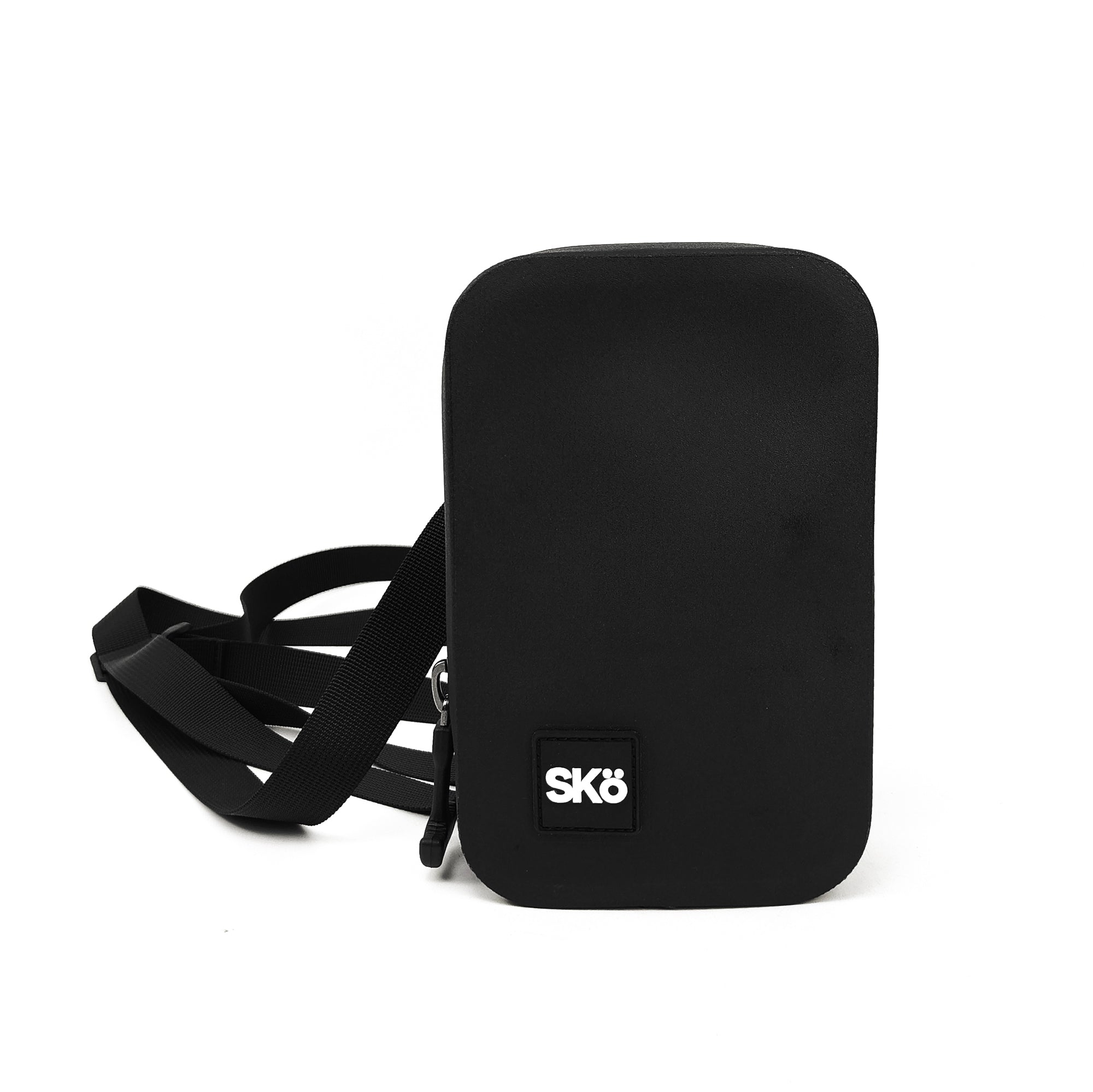
Keep the phone, car key and wallet in one waterproof place.
The SKÖ Waterproof Crossbody is compact waterproof carry for the small essentials you do not want loose under deck bungees or sitting in a shorts pocket. For additional small-item options, compare the best waterproof crossbody bags.
SKÖ currently publishes an IPX8 rating, approximately 1.14 L capacity, 1680D TPU construction, a waterproof zipper and dimensions of 7.5 × 4.7 × 2 inches. The product page describes the finished bag as waterproof and submersible when properly closed and sealed.
Sources
- U.S. Coast Guard Boating Safety, Frequently Asked Questions
- U.S. Coast Guard, Life Jacket Wear Guidance
- U.S. Coast Guard, A Boater's Guide to Federal Requirements for Recreational Boats
- American Canoe Association, SUP Leashes Safety Guidance
- REI Expert Advice, Paddle Board (SUP) Buying Guide
- REI Expert Advice, How to Stand Up Paddleboard for Beginners
- REI Expert Advice, How to Size and Use a SUP Paddle
- SKÖ Gear, Waterproof Crossbody Product Specifications
Paddle Boarding Essentials for Beginners
Last updated: August 17, 2026

The gear list is short. The part beginners skip is almost always the safety half, not the fun half.
A beginner needs six things to paddle board: a board 32–34 inches wide for stability, a paddle, a pump for inflatables, a leash, a Coast Guard–approved PFD, and a way to keep a phone and keys dry. Everything else — dry bags, a wetsuit, a roof rack — is optional and depends on where you're paddling.
Since 2008, the U.S. Coast Guard has classified SUPs as vessels once you're outside a designated swim, surf, or bathing area — which means paddlers 13 and older need a Coast Guard–approved life jacket on board (worn or not), paddlers 12 and under must wear theirs, and you need a whistle if you're out past the immediate shoreline (NRS). Inside a swim zone, none of that applies — which is part of why so many beginners never learn the rule exists.
What do you need for your first paddle boarding session?
A board (32–34 in wide for beginners), a paddle sized to your height, a pump if it's inflatable, a leash, and a Coast Guard–approved PFD — worn or on board depending on your age and location. Practice in calm, flat water away from boat traffic before progressing to rivers or open water.
The Core Gear List
- Board — 32–34 in wide, planing hull (flat, wide, rounded nose) for beginner stability
- Paddle — length roughly 6–10 in taller than you
- Pump — electric pumps are worth it for inflatables; hand pumps work but take 10–15 minutes
- Leash — ankle leash for flat water and surf; quick-release waist leash for moving water
- Coast Guard–approved PFD, sized correctly and within reach even when not worn
- A way to keep your phone, keys, and car fob dry and attached to you, not the board
Inflatable boards (iSUPs) are the better call for almost every beginner — they deflate into a backpack, take a pump-up to about 12–15 PSI, and are more forgiving than a hard board if you drop them or bump a dock. A hard board tracks slightly better once you're comfortable, but it needs a roof rack and is less forgiving of the wobbly first few sessions.
Practice somewhere flat and calm first — a no-wake lake, a bay, or a slow section of river — and check wind before you launch; anything over 10 mph makes paddling back to shore genuinely difficult. A quick lesson from a local outfitter or the American Canoe Association's Smart Start program covers fall recovery and reading conditions in about an hour, worth it before you go out alone.
A typical first session: calm bay, mid-morning before wind picks up, PFD strapped to the deck rather than worn since it's inside a swim zone, phone clipped in a pocket or pouch instead of a pants pocket. Falling in twice in the first twenty minutes is normal — the leash keeps the board within reach both times instead of drifting off.
People Also Ask
Do you need a life jacket to paddle board?
Yes, once you're outside a designated swim, surf, or bathing area. Paddlers 13 and older must have a Coast Guard–approved PFD on board (worn or not); paddlers 12 and under must wear theirs at all times. Inside a swim zone, you're exempt from the requirement.
What size paddle board should a beginner buy?
Look for 32–34 inches wide with a planing hull — flat, wide, and rounded like a surfboard. Width affects first-session stability more than length. A shorter, wider board will feel steadier than a longer, narrower one even though it's slower.
Sources
If you want your phone and key to stay dry and out of the way while you paddle, this is the kind of thing a waterproof crossbody solves without adding bulk to what's already a minimal gear list.
$80 · Limited Lifetime Warranty