


SKÖ vs YETI SideKick Dry 3L: Which Waterproof Bag Is Better?
SKÖ vs YETI
SideKick Dry 3L
Both are made to keep valuables dry around serious water, but they solve the job differently. SKÖ is a compact wearable crossbody. YETI's SideKick Dry 3L is a larger waterproof gear case built around a HydroShield magnetic closure, RF-welded seams and YETI's cooler-and-bag ecosystem.

SKÖ Gear publishes this comparison and manufactures the SKÖ Crossbody. We use current manufacturer specifications, clearly separate published facts from editorial judgment, and call out categories where YETI has the advantage. No independent lab test of the YETI SideKick Dry 3L was performed for this article. Prices, specifications and availability can change.
Crossbody or gear case?
That is the real decision.
Choose SKÖ if you want a compact waterproof bag that is already designed to wear crossbody. Choose the YETI SideKick Dry 3L if you want substantially more room, flotation, magnetic access and easy integration with YETI coolers and bags. If you want to wear the YETI crossbody, its Sideclick Strap is sold separately.

Best fit for compact wearable valuables carry
Choose SKÖ when the goal is to keep a phone, wallet, keys and a few small essentials on your body without stepping up to a 3-liter gear case.
- Approx. 1.14 L capacity
- 1680D TPU construction
- 13 oz published weight
- Crossbody strap included

Best fit for capacity, quick access and YETI integration
Choose the SideKick Dry 3L when you want a larger waterproof case for a phone, wallet, fishing license, sunblock, snacks and similar day-on-the-water gear.
- 3 L capacity
- HydroShield magnetic closure
- RF-welded seams
- Floats when fully sealed
The specs that actually matter.
This comparison is specifically about the YETI SideKick Dry 3L. YETI also sells other SideKick Dry sizes, so make sure you are comparing the same version.
| Category | SKÖ Waterproof Crossbody | YETI SideKick Dry 3L |
|---|---|---|
| Price reviewed | $80SKÖ direct | $55YETI direct |
| Crossbody-ready price | $80Strap included | $75$55 case + $20 Sideclick Strap |
| Published water protection | IP68 shown by SKÖ No depth/time figure on current product page | Waterproof No IP or depth/time rating on current YETI 3L page |
| Capacity | Approx. 1.14 L | 3 L |
| Dimensions | 7.5 × 4.7 × 2 in | 11.8 × 6.9 × 3.0 in Current main YETI 3L product page |
| Empty weight | 13 oz | 0.5 lb / 8 ozCase only; optional strap not included |
| Body construction | 1680D TPU | DryHide shell YETI compares the material to high-performance whitewater raft construction |
| Seams | Waterproof construction | RF-welded seams |
| Closure | Waterproof zipper | HydroShield magnetic closure + hook-and-loop |
| Floats | Not stated on current product page | Yes, when fully sealed |
| Wear style | Crossbody, front or side | Belt, YETI attachment points, or optional Sideclick Strap |
| Crossbody strap included | Yes | NoSideclick Strap sold separately |
| Warranty | See current SKÖ warranty terms | 3 years |
* Prices and specifications checked October 5, 2026. YETI's main 3L product page currently lists 11.8 × 6.9 × 3.0 inches and 0.5 lb. Always confirm the exact live SKU before purchase.
Both are waterproof, but they communicate it differently.
SKÖ publishes an IP68 designation for its Crossbody. YETI calls the SideKick Dry 3L waterproof and says the HydroShield magnetic closure must be fully closed and free of debris or obstructions.
The important difference is what is not published. YETI's current 3L product page does not give an IP code or a specific depth-and-duration immersion limit. SKÖ publishes IP68, but its current Crossbody page does not publish a depth/time figure either. That means neither product should be assigned an invented immersion depth in this comparison.
SKÖ has the clearer standardized ingress-protection designation. YETI gives very clear closure instructions. For real-world use, correct closure matters as much as the headline waterproof claim.
Published standardized rating. Current Crossbody page does not state a specific depth/time limit.
HydroShield must be fully closed and clear of debris. Current 3L page does not publish an IP or depth/time rating.
Zipper versus magnets is the most interesting part of this matchup.
SKÖ uses a waterproof zipper. YETI uses powerful magnets backed by hook-and-loop. The two systems create very different access patterns and maintenance considerations.


YETI's closure is one of the SideKick's clearest differentiators. The magnets create the waterproof seal, while the hook-and-loop closure adds another layer of security. YETI repeatedly warns that debris or obstructions in the magnetic path can compromise waterproof performance.
SKÖ's waterproof zipper is a more traditional sealing approach for a wearable waterproof bag. It requires deliberate closure and occasional care, but it avoids magnets and keeps the opening format closer to a normal zippered crossbody.
Neither wins universally. YETI's magnetic opening is distinctive and convenient for repeated access. SKÖ's zipper is a familiar wearable-bag format. If you have a pacemaker or implantable defibrillator, YETI specifically warns that the SideKick's magnets may cause interference.
YETI gives you about 2.6× the published capacity.
The SideKick Dry 3L is simply a larger storage format. Yet YETI publishes a case weight of only half a pound, which is lighter than SKÖ before adding the optional Sideclick Strap.
YETI publishes roughly 2.6× the capacity.
YETI's published case weight is about 38% lower, but the optional wearable strap is not included.


Capacity is the most practical difference between these two products. If all you want is a phone, wallet, keys and sunglasses, 3 liters may be more than you need. If you want those items plus sunblock, snacks, fishing tackle or other extras, YETI's extra volume is a real advantage.
The weight comparison deserves one caveat: YETI's 0.5-pound figure is for the SideKick case itself. The Sideclick Strap is sold separately and YETI does not publish its weight on the current strap page, so we would not claim an exact crossbody-ready weight advantage.
SKÖ publishes the denier.
YETI publishes the construction system.
The two brands describe material quality differently. SKÖ gives a 1680D TPU specification. YETI uses its DryHide name and emphasizes an abrasion-resistant shell paired with RF-welded seams.
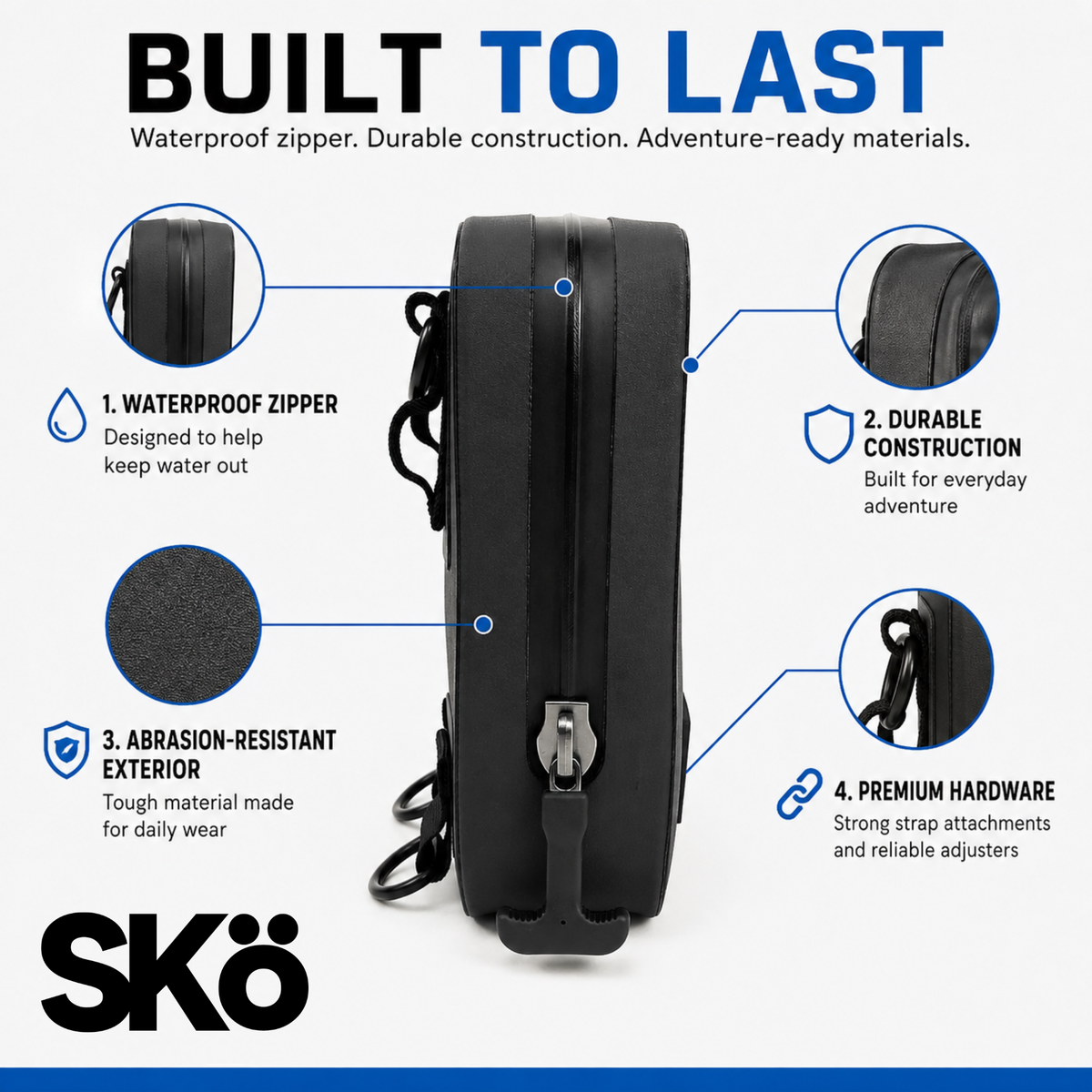
A dense published fabric specification in a compact waterproof crossbody.

A waterproof shell system built around abrasion resistance and welded construction.
We would not turn either description into a durability winner without controlled abrasion, puncture, seam-fatigue and closure testing on both finished products. A higher denier number is useful information, but durability depends on the complete system.
The fairest summary is this: SKÖ gives you a specific heavy fabric number; YETI gives you a well-defined shell, seam and closure architecture.
SKÖ is a crossbody first.
YETI is a gear case first.
This distinction matters more than the brands' marketing language. One is wearable out of the box. The other becomes a crossbody when you add a separate accessory.


YETI's modularity is a major advantage if you already own a Hopper soft cooler, Camino Carryall or Panga backpack with compatible attachment points. The SideKick can live on that gear and come off when you need it.
SKÖ is simpler if you just want a waterproof crossbody. There is no accessory decision and no need to convert a gear case into wearable carry. That makes SKÖ the more direct product for someone shopping specifically for a waterproof crossbody rather than a modular dry-storage pouch.
The SideKick's magnets are a feature.
They also deserve one important note.
YETI explicitly warns that the SideKick's magnets may interfere with pacemakers and implantable cardioverter defibrillators.
YETI's FAQ also addresses the earlier SideKick magnet-strip recall. The company says the current magnet strip is fully encapsulated within thermoplastic polyurethane to mitigate the risk of magnets falling out.
Do not treat the magnet warning as a minor footnote if you use an implanted cardiac device. For everyone else, the magnetic closure is one of the SideKick's defining features and should be kept clean and unobstructed for waterproof performance.
The best choice changes with the activity.
The SideKick wins when you want a larger waterproof gear pouch around boats and fishing setups. SKÖ makes more sense when you want less bulk and more direct on-body carry.
You want a waterproof gear case with more room.
The 3 L capacity, flotation, magnetic closure and YETI attachment ecosystem make the SideKick especially compelling for boating, fishing, paddleboarding and cooler-centered water days.
- You already use YETI Hopper, Camino or Panga gear
- You want room beyond just phone, wallet and keys
- You want a pouch that floats when fully sealed
- You prefer magnetic access over a waterproof zipper
You want the smaller wearable bag.
SKÖ is the more direct choice when you want essentials kept close to your body in a compact waterproof crossbody without buying a separate strap.
- You want a true crossbody out of the box
- You prioritize compactness over extra storage
- You want a published IP68 designation
- Your use leans toward kayaking, travel, hiking and all-day wearable carry
| Use case | Better fit | Why |
|---|---|---|
| Boating | YETI | 3 L, flotation and compatibility with YETI gear |
| Fishing | YETI / depends | More volume and modular attachment; SKÖ is smaller for minimal valuables |
| Paddleboarding | Depends | YETI for capacity and flotation; SKÖ for a smaller wearable footprint |
| Kayaking | Depends | SKÖ for compact on-body carry; YETI for more dry storage |
| Travel | SKÖ / depends | Built-in crossbody carry and smaller size versus YETI's extra volume |
| Minimal phone-wallet-keys carry | SKÖ | Smaller 1.14 L profile and strap included |
| Extra gear / snacks / sunblock | YETI | 3 L capacity |
| Existing YETI ecosystem | YETI | HitchPoint compatibility with selected YETI bags and coolers |
YETI is $55 as a gear case.
$75 as a crossbody-ready setup.
At the prices reviewed, the SideKick Dry 3L costs $55 and the Sideclick Strap costs $20. That puts the wearable YETI setup at $75 before tax, versus $80 for the SKÖ Crossbody with its strap included.
That five-dollar difference is too small to drive the decision. YETI gives you more published capacity and a lower case-only weight. SKÖ gives you the more compact form, a standardized IP68 designation, a 1680D TPU specification and an integrated crossbody use case.
If you already plan to keep the SideKick attached to a cooler, bag or belt, the $55 base price is a legitimate YETI advantage. If you are comparing them strictly as crossbody bags, use the $75 YETI-plus-strap figure instead of pretending the $55 gear case is directly equivalent.
Which one should you buy?
YETI wins on published capacity, case-only weight, flotation, modular attachment and base price. SKÖ wins on compactness, standardized IP designation, published fabric denier and being a true crossbody out of the box. The most important takeaway is that these products overlap, but they are not interchangeable.
You want the better waterproof gear case.
Buy the SideKick Dry 3L if you want more room, magnetic access, flotation and compatibility with YETI coolers and bags.
You want the more direct waterproof crossbody.
Buy the SKÖ Crossbody if you want phone-wallet-keys carry in a smaller wearable package with the strap already included.
Questions people ask before choosing.
Is the YETI SideKick Dry 3L actually waterproof?
Yes. YETI describes it as waterproof when the HydroShield magnetic closure is fully closed and free of debris or obstructions. YETI also recommends engaging the hook-and-loop closure as an additional line of defense.
Does the YETI SideKick Dry 3L have an IP rating?
YETI does not publish an IP rating on the current 3L product page. SKÖ publishes IP68 for its Crossbody. Neither current product page provides a specific depth-and-duration immersion limit that we would convert into a head-to-head depth claim.
Does the YETI SideKick Dry 3L float?
Yes. YETI says the SideKick Dry 3L floats when it is fully sealed.
Can the YETI SideKick Dry 3L be worn crossbody?
Yes, with the Sideclick Strap. YETI sells that strap separately for $20 at the time of this review. The strap adjusts for crossbody or waist carry.
Which is bigger, SKÖ or the YETI SideKick Dry 3L?
YETI is much larger by published capacity: 3 L versus approximately 1.14 L for SKÖ. YETI's main 3L page lists exterior dimensions of 11.8 × 6.9 × 3.0 inches.
Which is lighter?
The YETI case itself. YETI publishes 0.5 lb, or 8 oz, while SKÖ publishes 13 oz. YETI does not publish the current Sideclick Strap weight, so an exact crossbody-ready weight comparison is not available.
Are the SideKick magnets safe around pacemakers?
YETI warns that the magnets may interfere with pacemakers and implantable defibrillators. Anyone using an implanted cardiac device should follow their medical-device guidance and YETI's warning rather than treating this as a normal bag feature.
Was the YETI SideKick Dry recalled before?
An earlier SideKick magnet design was recalled. YETI's current FAQ says the new magnet strip is fully encapsulated within thermoplastic polyurethane to mitigate the risk of magnets falling out. This comparison is about the current product.
Which is better for kayaking?
SKÖ is the better fit if you want a smaller on-body essentials bag. YETI is better if you want 3 L of storage, flotation and more room for extras.
Which is better for fishing?
YETI has strong advantages for fishing because of the larger capacity, floating design and compatibility with other YETI gear. SKÖ makes more sense if you only want a small valuables pouch on your body.
How we built this comparison.
We prioritize manufacturer-published specifications, flag missing performance data instead of inventing it, and separate objective specifications from our editorial judgment about which design fits which use case.
SKÖ Gear manufactures one of the products in this comparison. That conflict is disclosed because a useful comparison should tell you where the competitor genuinely wins instead of forcing the home product to win every category.

Small essentials.
Built for bigger adventures.
Phone, keys, wallet and the things you do not want to leave behind.