
How to Keep Your Phone & Wallet Dry While Traveling
The best travel setup is not the bag with the biggest waterproof claim. It is the one that protects the valuables you actually carry through airports, rain, boats, pool days and hotel transfers without creating a new problem every time you need your phone or passport.
Keep your highest-consequence small items in one dedicated protective zone: phone, wallet, key, required ID and travel documents when you need them with you. For ordinary airport and city travel, a well-designed water-resistant organizer may be enough. If your trip includes boats, beaches, pools, heavy rain or a realistic chance of complete immersion, move those same items into an enclosure whose manufacturer explicitly supports that level of water exposure. Keep backup copies of important travel documents separate from the originals. For multi-activity excursions, our adventure travel essentials guide covers a broader packing setup.
Most trips do not require submersible gear every minute.
The old version of this article treats a submersible crossbody or pouch as the single best answer for nearly every travel day. That is too broad.
Airport terminals, museums and dry-city walking do not create the same water exposure as kayaking, a tropical downpour, an open-boat transfer or a hotel pool. A water-resistant organizer can be perfectly reasonable for ordinary rain. A true waterproof or submersible enclosure becomes more relevant when the failure consequence is high and the exposure is more severe.
The better system is to keep the same small valuables grouped together, then change the protection level when the trip changes from dry transit to real water.
Your water risk changes five times before the vacation is over.
Phone, wallet and ID move through pockets, security bins and bags. Losing track of them is often a bigger risk than water.
Passing showers, wet tables and a drink spill call for everyday weather protection rather than dive-level gear.
Spray, wet seats and an accidental drop create a much stronger case for a sealed waterproof enclosure.
If the valuables are coming into the water with you, choose a product whose maker explicitly supports immersion.
Wet towels, sunscreen and damp swimwear should not be stored beside electronics in the same sealed compartment overnight. See our guide to protecting electronics from humidity while traveling, especially on extended trips.
Not every “waterproof” problem is the same problem.
Product names are inconsistent. Instead of buying by adjective, ask what could physically happen to the bag that day.
Airport, train, museum, hotel lobby.
- Main problem: organization
- Water threat: small spills
- Typical need: ordinary organizer
Walking between transit, restaurants and hotels.
- Main problem: rain
- Water threat: sustained weather
- Typical need: proven rain protection
Spray, splashes, wet surfaces and shallow drops.
- Main problem: heavier wet exposure
- Water threat: spray + accidental dunk
- Typical need: waterproof enclosure
The bag or pouch may go completely underwater.
- Main problem: submersion
- Water threat: complete immersion
- Typical need: explicit submersion claim
Do not scatter your trip across six pockets.
Think of the protective bag as a “consequence zone.” It is for the few items that create the biggest problem if they get soaked, lost or left behind.
Communication, boarding information, maps, payment and travel documents often live on the same device, so one wet-phone failure can compound quickly.
Carry only what the day needs rather than moving the entire wallet into every beach, boat or pool environment.
A key fob is easy to forget because you rarely touch it after parking. Treat it as an immersion-sensitive electronic unless its maker says otherwise.
Keep required travel documents protected and accessible, but maintain backup copies separately rather than putting the original and every backup in one bag.
Consolidate small valuables, but follow the checkpoint process.
TSA's current checklist tells passengers in standard screening to empty keys, currency, wallets and cell phones from their pockets and notes that valuable items can be placed in carry-on baggage. It also tells travelers to check the bins and collect all belongings afterward.
That makes it easier to transfer the whole group into the appropriate carry-on location rather than discovering a phone in one pocket and a wallet in another.
Checkpoint instructions and officer directions govern what must come off your body or out of pockets. Design the system so it can move cleanly into the carry-on when required.
Before leaving the checkpoint area, confirm phone, wallet, key and required documents are back where you expect them to be.
At the airport, fast organization and not losing the items often matter more than submersion resistance.
Protect the original. Separate the backup.
Original document set
- Passport or ID required for the current part of the trip
- Required visa or travel authorization documentation when applicable
- One accessible payment method
- Keep protected from water, loss and unnecessary handling
Backup set
- State Department recommends multiple copies of required travel documents
- Keep one set separate from the originals
- Give another set to a trusted friend or family member
- Take photos of important documents on your phone as an additional reference
Dry transit in the morning. Pool deck by afternoon.
This is the reason a travel article should not force every traveler into one carrier. A modular system lets you use the right enclosure when the day changes. For carry styles by trip type, compare our best hands-free travel bags.
Keep phone, wallet, key and required ID grouped so they can move into carry-on screening cleanly and come back out together.
If the forecast is ordinary rain, a reliable weather-protective bag may be enough. Do not carry dive-level gear just for the label.
When spray, wet surfaces or an accidental dunk becomes plausible, use a true waterproof enclosure built for that exposure.
If the enclosure is coming into the water with you, “water-resistant” is no longer the relevant specification.
Choose by exposure and access, not by one “best” label.
Humidity can travel inside the bag with you.
Sea to Summit warns that condensation can form inside a waterproof enclosure. Moist humid air sealed in a bag can cool later and deposit water inside even when no outside leak occurred.
A damp swimsuit, wet lanyard or sunscreen-covered towel can create the moisture problem from inside the enclosure.
Wipe out droplets and let the interior dry before sealing everything for the next morning.
If moisture appears without an obvious leak, consider humid air and wet contents before diagnosing the bag.
Sea to Summit recommends extra protection for electronics in very wet environments rather than relying casually on a generic roll-top dry bag.
Ten minutes tonight prevents the wet-bag problem tomorrow.
Remove everything wet.
Swimwear, damp straps, towels and sunscreen should leave the valuables compartment at the end of the day.
Check the closure.
Sand, salt, lotion and grit can collect where a waterproof zipper, gasket or pouch seal needs to close cleanly.
Leave the enclosure open.
If moisture made it inside, let the slowest-drying corners and straps dry before closing the bag for storage.
Only tomorrow's essentials go back.
Reducing the valuables kit makes the bag easier to close, easier to carry and easier to inspect before leaving the room.
Protection fails when the system gets sloppy.
Skip these habits
- Assuming every “waterproof” travel bag is submersible
- Keeping wet swimwear beside the phone
- Putting original passport and every backup copy in one pouch
- Leaving a phone, wallet and cash loose in multiple checkpoint bins
- Overstuffing a phone pouch beyond its intended shape
- Ignoring sand, sunscreen or grit in the closure
- Closing the bag overnight while the inside is still damp
Use these habits instead
- Match water protection to the day's real exposure
- Keep the small valuables kit consolidated
- Move valuables into carry-on as checkpoint rules require
- Keep document backups separate from originals
- Read the actual immersion claim before water activities
- Inspect and close the seal exactly as instructed
- Dry the enclosure open after wet use
The 45-second valuables check.
Phone + wallet travel protection checklist
Keeping travel valuables dry.
What is the best way to keep a phone and wallet dry while traveling?
Keep them together in one small protective enclosure whose water protection matches the day's exposure. For normal city travel, a rain-resistant organizer may be enough. For boating, beaches, pools or realistic immersion, use a waterproof enclosure whose maker explicitly supports that exposure.
Do I need a submersible bag for normal travel?
Not necessarily. Airports, trains and ordinary sightseeing are mostly organization and weather problems. Submersible protection becomes more useful when the trip actually includes heavy water exposure or complete immersion.
Should I keep my passport in the same waterproof bag as my phone?
If you need to carry the passport with you that day, keeping it protected can be sensible. But the U.S. State Department recommends multiple copies of important travel documents, including a set stored separately from the originals and another left with a trusted person.
What should I do with my phone and wallet at airport security?
Follow current TSA screening instructions and officer directions. TSA's checklist says passengers in standard screening should empty items such as keys, currency, wallets and cell phones from pockets, and that valuable items can be placed in carry-on baggage. Check the bins before leaving the checkpoint.
Can a zip-top plastic bag protect my phone?
A household zip-top bag can be a useful temporary splash barrier, but it generally does not provide the same published immersion specification, durable closure system or long-term wear information as a purpose-built waterproof electronics enclosure. Treat it as a backup rather than assuming it is equivalent to a rated case or bag.
Why is there moisture inside my waterproof bag if it did not leak?
Condensation is one possibility. Sea to Summit notes that condensation can form inside waterproof electronics storage. Humid air or damp contents sealed inside the enclosure can produce moisture later as conditions change.
Keep your travel essentials protected


One compact waterproof zone for the high-consequence essentials.
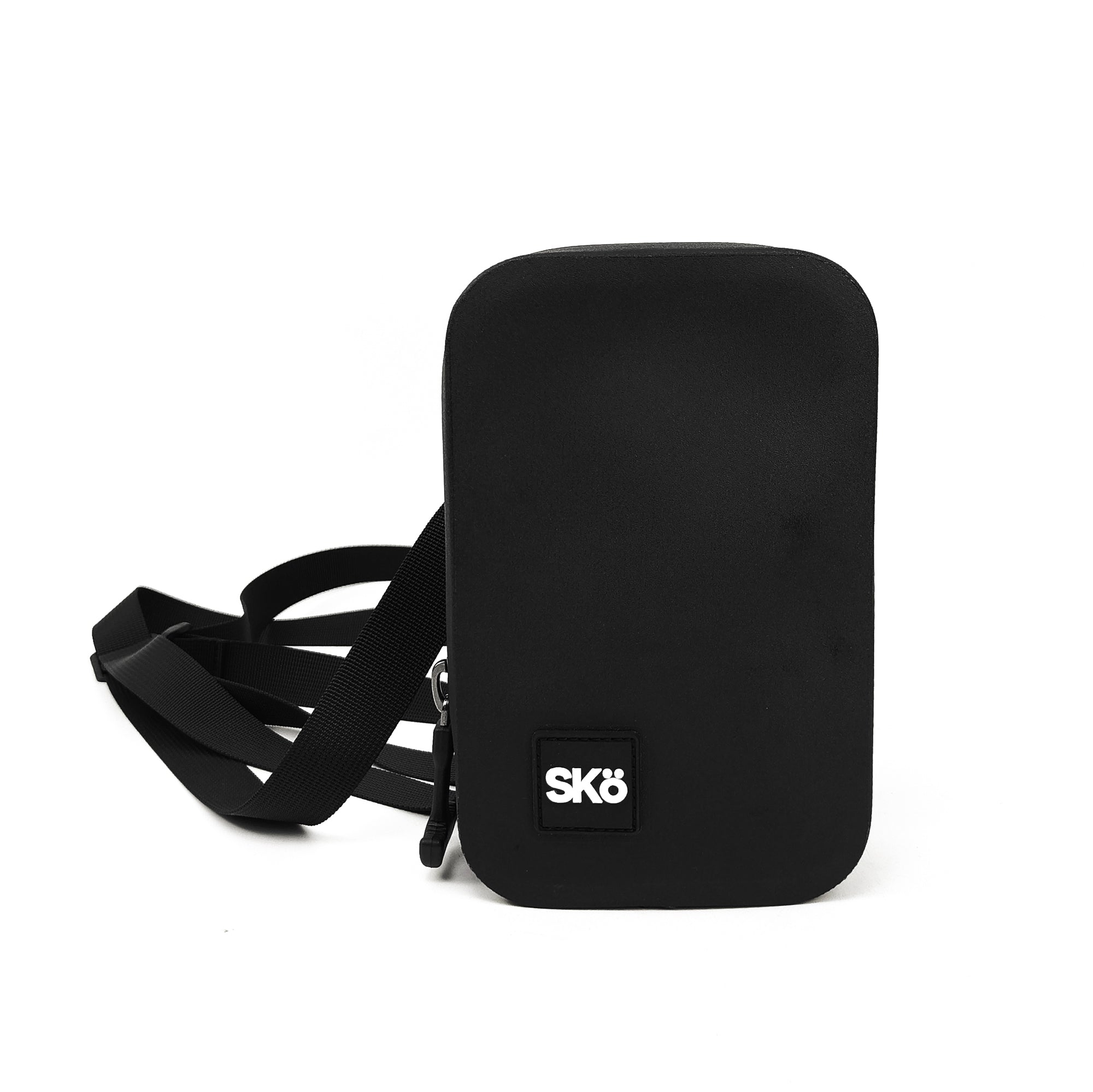
The SKÖ Waterproof Crossbody is designed for the phone, wallet, keys, passport and other small valuables that you want together and protected. It is intentionally smaller than a daypack and does not need to carry towels, clothing or snacks.
SKÖ currently publishes an IPX8 rating, approximately 1.14 L capacity, 1680D TPU construction, a waterproof zipper, dimensions of 7.5 × 4.7 × 2 inches and an approximate weight of 13 oz. The current product page describes the finished bag as waterproof and submersible when the zipper is fully and properly closed.
SKÖ does not currently publish a universal immersion depth or duration for the Crossbody, so this guide does not invent one.